

Product Basics
What is the R-value of Solar-SNAP?
R-value is a measurement of resistance to conductive heat (by touch). Since radiant barriers block radiant heat (electromagnetic waves, empty space) R-values don’t apply.
Instead, radiant barriers are measured by reflectivity(how much heat is reflected away) and emissivity (how much heat is allowed through). The reflectivity of Solar-SNAP is up to 97% and the Emissivity value is 3%.
What is Solar-SNAP and how does it work?
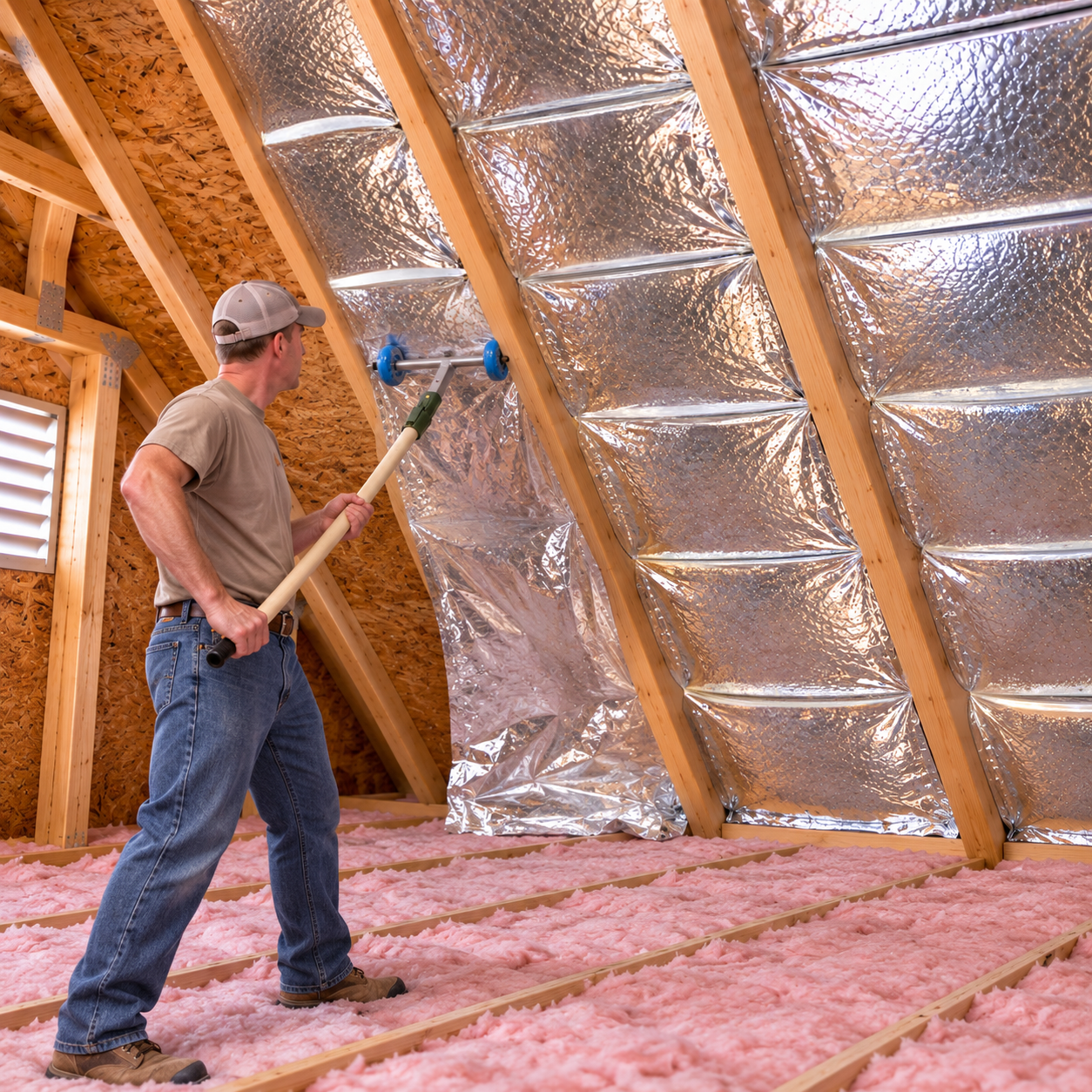
Solar-SNAP is a reflective radiant barrier system intended to reduce radiant heat transfer. Its integrated spring-steel battens are designed to help position and secure the barrier during installation.
What makes Solar-SNAP different from staple-up radiant barriers?
Solar-SNAP uses integrated battens rather than relying on traditional staple-up attachment alone. Refer to the Solar-SNAP Resources Center for installation details and comparisons.
What widths are available?
Solar-SNAP is available in 16-inch and 24-inch product formats. Verify the correct format for your framing and project requirements before ordering.
Installation
Will Solar-SNAP cause roof shingles to deteriorate?
Download or View the Florida Solar Energy Center study.
What kind of airspace is needed?
Can Solar-SNAP be removed for future inspections?
How are the spring-steel battens installed?
Review the illustrated installation instructions and tool guidance in the Solar-SNAP Resources Center before beginning your project.
Can Solar-SNAP be removed for future inspections?
The batten-based attachment system is designed with access in mind. Review the applicable installation guidance for safe removal and reinstallation procedures.
Performance & Comfort
Is Solar-SNAP only for hot regions? Do they work in cold climates as well?
How does Solar-SNAP help improve comfort in a building?
Can Solar-SNAP be used in new construction and retrofit projects?
What is the expected savings?
The savings of Solar-SNAP is difficult to predict, because it is based on so many factors. We have seen savings of up to 35%, but that kind of savings is not expected for everyone.
Some factors that can affect savings are
- Ductwork location– Ductwork in attic=more potential savings
- Weather Conditions – Hot, sunny regions will see more significant savings
- Size and style of home – Larger homes often see higher dollar savings
- Lifestyle – Increased potential savings when thermostat is set low during summer. If you keep your thermostat higher, the baseline energy use is already lower, so the dollar savings will be lower.
- Amount of insulation in attic – Homes with low level insulation will see a dramatic boost in savings from Solar-SNAP
Remember, Solar-SNAP also provides indirect savings, such as:
- Reduced HVAC wear. (fewer cycles, longer lifespan)
- Improved ductwork efficiency. (if ducts are in attic)
- Potential storage options due to lower temperatures in attics.
- Upstairs bedrooms that are actually comfortable in the summer.
- More consistent temperatures throughout your home.
Does it replace insulation?
How does Solar-SNAP help improve comfort in a building?
Radiant barriers are designed to reduce radiant heat transfer. Actual results depend on climate, building configuration, installation quality, and other site conditions.
Can Solar-SNAP be used in new construction and retrofit projects?
Solar-SNAP can be considered for both types of projects when the installation conditions are suitable. Consult the installation resources for project-specific requirements.
Material Estimating
I want to test my video embed element to ensure I can render these nice videos.
How much Solar-SNAP material do I need?
Start with the material estimator in the Solar-SNAP Resources Center, then verify your roof dimensions, framing, and project conditions.
Does the material estimator account for waste and overlaps?
Estimator assumptions should be verified against the current calculator and your actual project measurements. Plan for appropriate cutting, fit, and site-specific waste.